
If you lead a nonprofit organization, I don’t need to tell you what it feels like to be stretched too thin. You’re managing programs, chasing grant deadlines, keeping up with board communications, handling donor relationships, posting on social media, and somehow trying to stay on top of the books — all at the same time, often with a team that’s doing the same.
The data confirms what you’re already living every day. According to the Center for Effective Philanthropy’s State of Nonprofits 2025 report, 90% of nonprofit leaders report some level of concern about staff burnout — and more than half say they feel more burned out themselves than in previous years. That’s not a staffing problem. That’s a systems problem.
A virtual assistant won’t solve every challenge facing your organization. But for many nonprofits, bringing in the right VA support is the difference between a team that’s surviving and one that’s actually thriving. Here’s what you need to know.
The Nonprofit Staffing Crisis Is Real — And It’s Getting Worse
Before we get into solutions, it’s worth sitting with the problem for a moment, because I think a lot of nonprofit leaders feel like they’re uniquely struggling when the reality is that this is a sector-wide crisis.
59% of nonprofits said it was significantly harder to fill staff positions in 2024 than in previous years, and nearly 1 in 3 nonprofits struggle with ongoing retention and turnover.
– PNP Staffing Group, 2024 Nonprofit Salaries & Staffing Trends, via Social Current
Salaries are part of the issue — 55% of nonprofits cite the inability to offer competitive pay as a significant challenge. But it goes beyond compensation. When teams are understaffed, everyone absorbs more work. When everyone absorbs more work, burnout follows. And when burnout leads to more departures, the cycle starts again.
The share of nonprofit leaders citing staff burnout as their top concern doubled from 4% in 2024 to 8% in 2025, according to Candid, citing Urban Institute analysis of national nonprofit survey data (April 2026). One respondent summed it up plainly: ‘We need more people, but we don’t have the budget to support the hires that would truly relieve pressure.’
– Candid insights, Canid.
This is the environment most nonprofit leaders are operating in right now. And it’s exactly why virtual assistant support — flexible, skilled, and a fraction of the cost of a full-time hire — is worth a serious look.
The Real Cost of a Full-Time Hire (vs. What You Actually Need)
One of the biggest misconceptions I hear from nonprofit leaders is that they can’t afford to get help. But when we look at the true cost of a full-time employee versus a skilled VA, the math often tells a very different story.
A mid-level administrative employee in the U.S. typically earns $45,000–$55,000 per year in base salary. But that’s only the starting point. Once you factor in payroll taxes, health insurance, retirement contributions, onboarding costs, and equipment, the total cost of that hire is closer to $70,000–$80,000 annually — before they’ve attended their first staff meeting.
Organizations can reduce operating costs by 30% or more by working with a virtual assistant compared to a full-time in-house hire — primarily by eliminating benefits, payroll taxes, and equipment costs. Savings can reach up to 78% when working with offshore VA providers.
– Remote Scouts, 2026
A virtual assistant works on a flexible, retainer or hourly basis. You pay for the hours and support you actually need — not for a full-time salary during slow seasons, not for benefits or payroll taxes, and not for office space. For a resource-conscious nonprofit, that flexibility isn’t just a convenience. It’s a strategic advantage.
And here’s something worth noting for your Form 990 and donor conversations: when VA support is used to directly support program activities — managing grant projects, coordinating volunteers, supporting communications — those hours can often be classified as program expenses rather than administrative overhead. That’s a meaningful distinction when donors and watchdog organizations are reviewing how your dollars are spent.
What a Nonprofit Virtual Assistant Can Actually Do
I want to be specific here, because ‘virtual assistant’ means different things to different people. The right VA for a nonprofit isn’t just someone answering emails. They’re a skilled operational partner who helps your organization run more smoothly — so your team can focus on mission delivery.
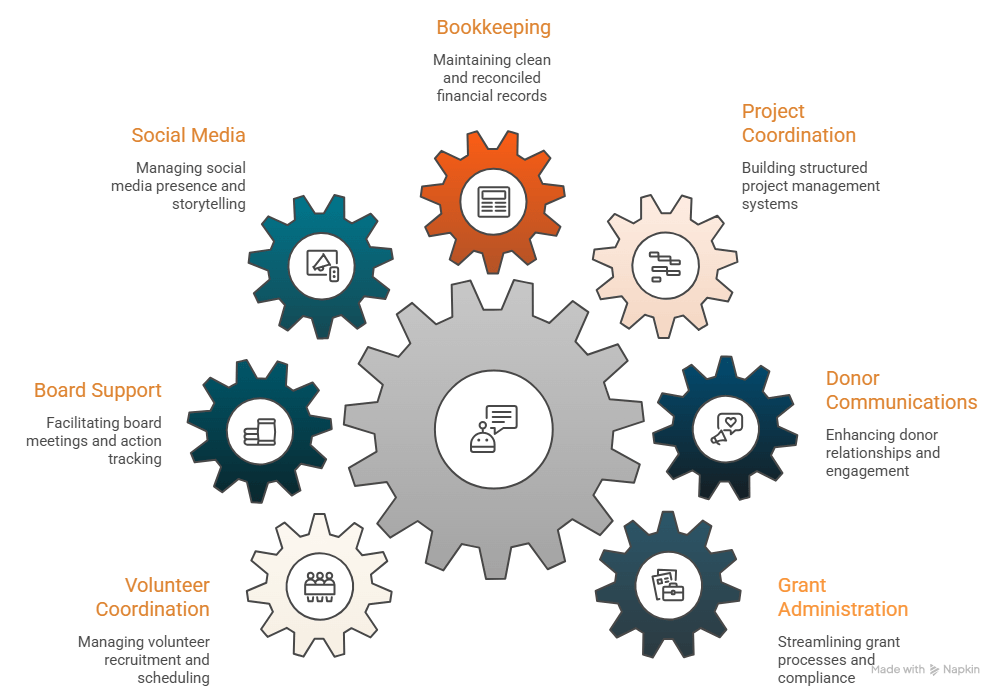
Here are some of the most impactful ways a virtual assistant can support a nonprofit:
Grant Administration Support
Grant deadlines, reporting requirements, and compliance documentation are some of the most time-consuming aspects of nonprofit operations. A VA with project management experience can set up grant tracking systems, create deadline calendars, compile reporting data, and manage the administrative side of grant cycles — freeing your program team to focus on doing the work, not documenting it.
Donor Communications and Database Management
Consistent, personalized donor communications build the relationships that sustain your mission. A VA can manage your donor database, send acknowledgment letters, draft newsletters, schedule thank-you calls, and keep your CRM updated — ensuring no donor falls through the cracks during busy seasons.
Project and Program Coordination
This is where I bring something a bit different to the table. As a PMP-certified virtual assistant, I help nonprofits build real project management infrastructure — not just task lists, but structured timelines, clear ownership, and accountability systems that keep programs on track even when staff capacity fluctuates. Many nonprofits run important programs on informal systems that work fine until they don’t. Building something more structured is one of the highest-ROI things a nonprofit can do.
Bookkeeping and Financial Support
As a QuickBooks ProAdvisor, I help nonprofits keep their books clean, reconciled, and ready for audit season. This includes expense tracking, grant expense reporting, bank reconciliation, and financial statement preparation. For smaller nonprofits that can’t justify a full-time bookkeeper, having a certified VA handle the books is a practical and affordable solution.
Social Media and Communications
Your mission deserves to be heard. A VA can manage your social media calendar, write and schedule posts, design simple graphics, draft email campaigns, and help you tell your organization’s story consistently — without your executive director spending hours on Canva every week.
Board and Meeting Support
Board meeting prep, agenda creation, minutes, and follow-up action tracking are all tasks that often fall to already-stretched staff. A VA can own this process end to end, ensuring your board has what they need and that commitments made in meetings actually get tracked and followed up on.
Volunteer Coordination
Recruiting, communicating with, and scheduling volunteers is meaningful work — but it’s also incredibly time-consuming. A VA can manage volunteer communications, maintain your volunteer database, send scheduling reminders, and handle the administrative layer of your volunteer program so your staff can focus on relationships.
What to Look for in a Nonprofit Virtual Assistant
Not every virtual assistant is the right fit for nonprofit work. The sector has its own culture, language, compliance requirements, and funding dynamics. When you’re evaluating VA support, here’s what I’d encourage you to look for:
- Experience with or genuine interest in the nonprofit sector. A VA who understands how nonprofits operate — the grant cycle, the board structure, the overhead sensitivity — will get up to speed faster and make fewer costly mistakes.
- Project management skills, not just task execution. The best VA support isn’t just about getting things done. It’s about building systems that keep things running even when your team is stretched. Look for someone with structured PM experience.
- Financial literacy. Nonprofit bookkeeping has specific requirements — expense categorization for Form 990, grant expense tracking, fund accounting. A QuickBooks ProAdvisor with nonprofit experience is worth looking for specifically.
- Clear communication and proactive follow-through. In a lean nonprofit environment, you can’t afford to chase down your VA. Look for someone who communicates clearly, surfaces problems early, and takes ownership of their work.
- Flexibility and a genuine stake in your mission. The best VA relationships in the nonprofit sector feel like partnerships. You want someone who cares about what you’re building — not just someone checking boxes.
A Note on Donor Perception and Overhead
I know some nonprofit leaders worry that bringing in outside support will look like overhead to donors. It’s a real concern, and it’s worth addressing directly.
The overhead myth — the idea that donors should only support organizations that spend as little as possible on administration — has been widely challenged by researchers and sector leaders for years.
In 2023, Charity Navigator actually removed the administrative expense ratio from its rating system, recognizing that this metric was misleading and often penalized organizations for making smart operational investments.
A virtual assistant who helps your team run more efficiently, track grant spending accurately, and communicate with donors consistently is not overhead in the pejorative sense. They’re infrastructure. And organizations that invest in the right infrastructure tend to serve their communities more effectively and sustainably than those that don’t.
Ready to Explore What This Could Look Like for Your Organization?
I’ve worked with nonprofits of all sizes — from small community organizations to larger associations — and I understand the particular pressures and priorities that come with mission-driven work. I’m not going to pitch you on a service package you don’t need. I’m going to listen to where you’re stretched, and be honest about where I can genuinely help.
If your nonprofit is navigating the current staffing and burnout challenges and you’re wondering whether virtual assistant support might be part of the answer — let’s chat!