“Project management virtual assistant” is one of those phrases that sounds self-explanatory until someone asks you to define it. And then it gets a little murky.
Is it someone who manages your to-do list? Coordinates your team? Builds out your project timelines? Sets up your ClickUp? All of the above? None of the above?
The answer depends significantly on who you hire — and specifically, whether that person has formal project management training or is simply a general VA who’s comfortable with project tools. As a Project Management Professional (PMP)® and virtual assistant with over 20 years of experience, I want to give you an honest, specific answer to this question — because the difference matters more than most people realize.
First, Why Project Management Matters So Much for Small Businesses
Before getting into what a project management VA does, it’s worth spending a moment on why this function is so critical for small businesses and nonprofits in the first place.
Organizations that don’t adequately include project management in their strategies experience a project failure rate of over 60%, according to PMI’s Pulse of the Profession research, cited by ClickUp (2026). By contrast, organizations with strong PM practices achieve a 92% success rate in meeting project objectives.
– ClickUp project management statistics 2026
That gap — between 60% failure and 92% success — doesn’t happen because some businesses have more talented people. It happens because some businesses have better systems. And for small businesses and nonprofits operating with lean teams, that system gap is almost always the thing standing between where they are and where they want to be.
37% of project failures stem from unclear goals and objectives, and 19% result from communication breakdowns within teams.
– Quixy, citing PMI data, 2025
Those two causes — unclear goals and communication breakdowns — are exactly what a skilled project management VA is built to prevent.
What a Project Management Virtual Assistant Actually Does
A project management virtual assistant handles the operational infrastructure that keeps your projects moving from idea to completion. That’s a broad definition, so let me break it down into the specific things this typically includes:
Project Planning & Setup
Before a project can run, someone has to build the structure it runs on. A PM VA creates the project plan — breaking down the goal into phases, milestones, tasks, and timelines. They set up your project management tool (Asana, ClickUp, Trello, Monday.com, Notion, or whatever fits your team best), assign ownership to tasks, and establish the workflow that everyone follows.
For small businesses without a dedicated ops function, this is often the highest-value thing a PM VA does. A well-built project structure takes hours to create and saves weeks of confusion.
Progress Tracking & Accountability
Once a project is running, someone has to watch it. A PM VA monitors task completion, flags items that are falling behind, follows up with team members or vendors who haven’t delivered, and surfaces problems before they become crises. This is the ongoing, day-to-day work that keeps a project on track rather than slowly drifting off course.
For most small business owners, this is the part that falls apart first. You set up the project, assign the tasks, and then get pulled back into client work — and three weeks later you realize nothing has moved.
Communication & Status Reporting
A PM VA keeps the right people informed at the right time. That might mean sending a weekly status update to your leadership team, facilitating a project check-in call, maintaining a shared project dashboard, or simply making sure everyone on the team knows what they’re doing and when it’s due. Clear communication is one of the most underrated project management functions — and one of the most impactful.
Process Documentation & SOPs
A skilled PM VA doesn’t just manage individual projects — they help you build repeatable systems. That means documenting your processes as standard operating procedures (SOPs) so that the way your team does things doesn’t live only in someone’s memory. When a team member leaves, a new one joins, or you simply need to delegate something you’ve always done yourself, the SOP is what makes that possible.
Tool Setup & Workflow Automation
Getting a team to actually use a project management tool is harder than it sounds. A PM VA selects the right tools for your workflow, sets them up correctly, trains your team on how to use them, and builds automations (using tools like Zapier or Make.com) that reduce the manual steps required to keep everything current. The goal is a system your team adopts because it makes their work easier — not one they ignore because it feels like more work.
Vendor & Stakeholder Coordination
Many projects involve people outside your core team — contractors, vendors, clients, board members, funders. A PM virtual assistant manages those relationships on the operational level: communicating timelines, collecting deliverables, following up on outstanding items, and making sure external dependencies don’t become bottlenecks.
What Makes a PMP-Certified VA Different From a General Virtual Assistant
Here’s the honest distinction that most people don’t know to ask about.
A general virtual assistant who is comfortable in Asana can help you manage tasks. They can create projects, assign due dates, and check things off when they’re done. That’s genuinely useful, especially for straightforward work.
A PMP-certified virtual assistant brings a structured, methodology-backed approach to how projects are planned, executed, and closed. The PMP credential — awarded by the Project Management Institute — covers scope management, risk identification, stakeholder communication, resource allocation, and quality control. It’s the difference between someone who can use the tool and someone who knows how to design the system.
Smaller businesses are 13% more likely to adopt project management tools than enterprise companies — but having the tools isn’t the same as using them well. (monday.com World of Work Report, 2025)
– monday.com project management statistics 2026
For a small business or nonprofit, that distinction matters. You don’t have the staff overhead to absorb a poorly structured project. You need someone who gets it right the first time — and who can scale the approach as your team and initiatives grow.
Signs Your Business Needs Project Management VA Support
Not every small business needs a PM virtual assistant right away. But there are some clear signals that it’s time to get serious about project management support:
- Projects regularly take longer than expected — not because the work is hard, but because nobody has a clear picture of what’s due when
- You’re the unofficial project manager for every initiative in your business, which means nothing moves when you’re focused elsewhere
- Your team is busy but the important things aren’t getting done — a sign that tasks are being managed without clear priority or accountability
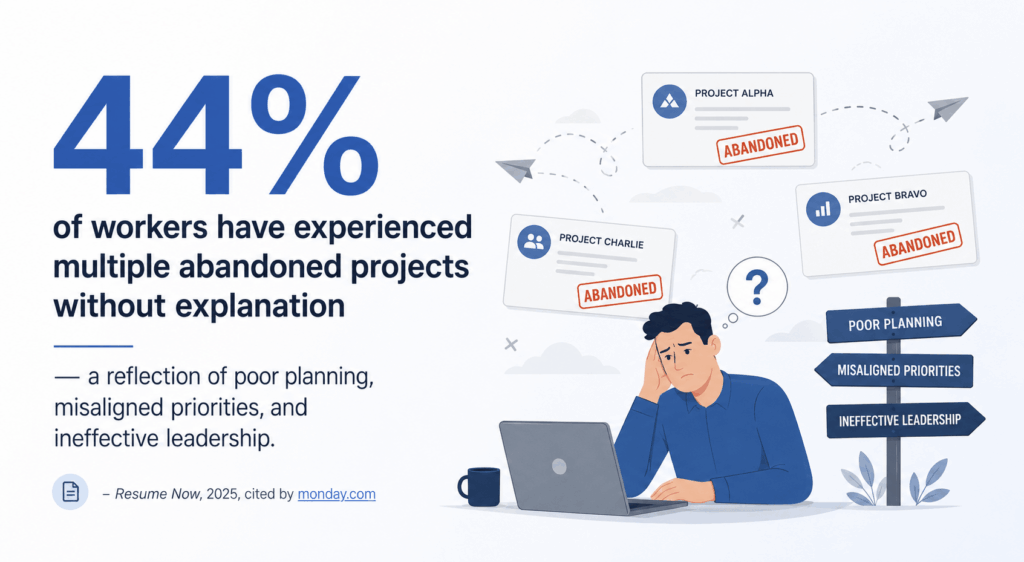
- You’ve started projects that quietly died — no formal close, no lessons learned, just a slow fade into inactivity
- You’re scaling and things are getting complicated — more clients, more team members, more moving parts than informal systems can handle
If two or more of these feel familiar, project management support isn’t a nice-to-have. It’s the thing that will determine whether your next phase of growth goes smoothly or creates more chaos.
What Working with a Project Management VA Looks Like in Practice
Every engagement looks a little different depending on what you need. But here’s a typical starting point for a small business or nonprofit working with me for the first time:
We start with a discovery conversation to understand what’s currently on your plate, what’s not moving, and what a successful outcome looks like for you. From there, I audit your existing tools and workflows, identify the gaps, and build a project structure that fits your team — not a template that everyone has to adapt to.
Within the first 30 days, most clients have a running project dashboard, documented SOPs for their most critical workflows, and at least one previously stalled initiative back in motion. The difference isn’t magic. It’s structure, follow-through, and someone who takes genuine ownership of the operational side of your work.
Ready to Talk About What This Could Look Like for You?
If your business is managing projects out of spreadsheets, email threads, and memory and you’re ready to build something more solid, I’d love to have a conversation. Let’s chat!