

If you’ve been handling your own books and you’re finally ready to hand them off — or if the books haven’t been touched in a few months and the stress of it is starting to show up everywhere — one of the first questions you’re probably asking is: how much is this going to cost me?
The honest answer is: it depends. And I know that’s not what you want to hear. But here’s what most small business owners don’t realize: the sticker price is rarely the whole story.
In this post I’m going to break down the real cost of bookkeeping for a small business in 2026 — from part-time freelancers to full-time in-house hires — and help you figure out which option makes the most sense for where your business is right now. I’ll also be upfront about where a QuickBooks ProAdvisor virtual assistant fits into that picture, and when it might be the most cost-effective option on the table.
What Does a Bookkeeper Actually Cost in 2026?
Bookkeeping costs vary significantly depending on three factors: how you hire (freelance, part-time, full-time, or outsourced), how complex your books are, and where you’re located. Here’s a breakdown of what you can realistically expect:
Freelance or Contract Bookkeeper
Freelance bookkeepers typically charge on an hourly basis. According to NerdWallet’s bookkeeping pricing guide, citing Bureau of Labor Statistics data, the median pay for bookkeepers in 2024 was $23.66 per hour. However, freelancers on platforms like Upwork tend to charge more — NerdWallet reports the average Upwork bookkeeping rate at $43 per hour, with rates ranging from there up to $80 or more depending on experience and specialization.
Hourly billing works well for one-off projects — catching up on several months of backlogged books, cleaning up a messy QuickBooks file, or preparing for tax season. For ongoing monthly bookkeeping, though, hourly billing tends to create unpredictable costs and often ends up more expensive than a flat-rate package.
Monthly Bookkeeping Packages
For small businesses that need consistent, ongoing support, monthly retainer packages are the most common and cost-effective structure. Based on current 2026 pricing data, here’s what most small businesses pay:
- Basic package (bank reconciliation, categorization, monthly reports): $300–$500/month
- Mid-tier package (above + A/P, A/R, payroll support): $500–$900/month
- Full-service package (above + CFO-lite reporting, audit prep, tax liaison): $900–$1,500+/month
Most small businesses pay between $300 and $1,500 per month for reliable bookkeeping services, depending on transaction volume and complexity.
– NerdWallet, updated March 2026
The right package for your business depends on how many transactions you process monthly, whether you need payroll support, the number of accounts you’re reconciling, and how detailed your financial reporting needs to be.
Part-Time In-House Bookkeeper
Some small businesses hire a part-time bookkeeper directly as an employee. This typically runs $21–$23 per hour for general bookkeeping duties, according to industry benchmarks. It can feel cheaper upfront — but remember that even a part-time employee triggers payroll taxes, and often requires supervision and management time from you or another team member.
Full-Time In-House Bookkeeper
A full-time bookkeeper is the most expensive option and, for most small businesses, more than you need. According to QuickBooks’ 2026 guide, a bookkeeper costs around $47,000 per year on average. GrowthForce puts the full-charge bookkeeper range at $48,000–$70,000 depending on location and experience — and that’s before you add benefits, payroll taxes, equipment, and office space, which typically add another 20–30% on top of salary.
For most small businesses and nonprofits, a full-time in-house bookkeeper is simply more than the volume of work requires — and the overhead it creates is hard to justify until you’re processing a very high volume of transactions each month.
What Drives Your Bookkeeping Cost Up (Or Down)
Before you budget for bookkeeping support, it helps to understand the factors that determine where on the pricing spectrum you’ll land:
- Transaction volume — The more transactions your business processes each month, the more work the bookkeeper has. A business with 50 monthly transactions pays far less than one with 500.
- Business complexity — Multiple bank accounts, credit cards, currencies, inventory tracking, or loan management all increase the complexity and cost of accurate bookkeeping.
- Software — Cloud-based platforms like QuickBooks Online reduce manual hours and therefore cost. Legacy systems or manual spreadsheets take more time and cost more.
- Reporting requirements — Basic monthly reports cost less than detailed CFO-level reporting, grant expense tracking for nonprofits, or audit-ready documentation.
- Location — Bookkeepers in high cost-of-living areas (DC, New York, California) charge more. Remote and virtual bookkeepers often offer meaningful savings regardless of your location.
- Catchup work — If your books are behind, expect a one-time cleanup fee before ongoing monthly work begins. This is typically billed as a project at $500–$5,000 depending on how far back and how complex.
Where a QuickBooks ProAdvisor Virtual Assistant Fits In
Here’s where I want to be transparent — because this question matters for a lot of small businesses I talk to.
A QuickBooks ProAdvisor virtual assistant occupies a specific and often overlooked sweet spot in the bookkeeping market: more specialized than a general virtual assistant, more affordable than a CPA firm, and more flexible than a full-time hire.
As a certified QuickBooks ProAdvisor, I’m trained and tested by Intuit on QuickBooks Online directly. That means I set up your books correctly from the start, catch categorization errors before they become tax problems, and deliver the reports your CPA actually needs. Because I work as a VA rather than an employee, you don’t pay benefits, payroll taxes, or equipment costs. And because bookkeeping is one service within a broader set of operational support I provide, my clients often find they can bundle bookkeeping with project management, admin, or social media support — getting more done for less than they’d pay managing separate vendors.
For small businesses that need consistent, monthly bookkeeping support and want to work directly with a credentialed professional rather than an offshore service or a generalist, this model tends to offer the best combination of quality and value.
When to Hire a CPA Instead
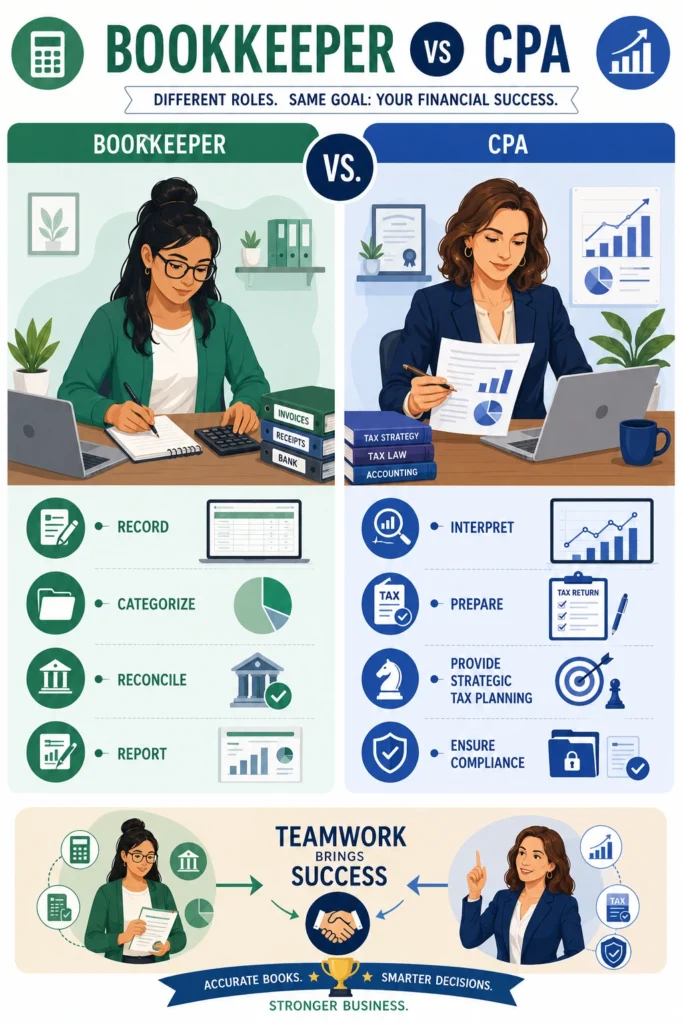
Bookkeepers and CPAs serve different functions — and it’s worth being clear about the distinction so you don’t overpay for what you actually need.
A bookkeeper handles the day-to-day recording, categorizing, reconciling, and reporting of your financial transactions. They keep your books accurate and current.
A CPA interprets your financial data, prepares your tax returns, provides strategic tax planning advice, and handles complex compliance requirements.
For most small businesses, the right model is: a bookkeeper handling the ongoing monthly work, and a CPA reviewing the year-end financials and filing the returns. Using a CPA for routine bookkeeping tasks is like using a surgeon to give you a physical — technically capable, but far more expensive than the situation requires.
A good bookkeeper — including a QuickBooks ProAdvisor VA — will serve as the liaison between you and your CPA, making sure your CPA has everything they need at tax time without you having to play phone tag or locate receipts from three years ago.
Ready to Stop Doing Your Own Books?
If you’ve been managing your own bookkeeping and it’s eating more time than it’s worth — or if you’re not entirely sure your books are accurate — I’d love to have a conversation about what bookkeeping support could look like for your business. Let’s chat!