

When a small business owner starts feeling the strain of doing too much themselves, the next question usually comes in one of two forms: ‘Should I hire someone?’ or ‘Should I get a virtual assistant?’
On the surface, it seems like a simple cost comparison. In practice, most small business owners are only looking at half the picture — because the true cost of a full-time employee goes well beyond what you see on a salary offer letter.
This post breaks down the real numbers so you can make an informed decision for your small business — not based on assumptions, but on what hiring actually costs in 2026.
The Hidden Cost of a Full-Time Employee
Let’s start with what most small business owners budget for: salary. Say you hire an administrative or operations employee at $55,000 per year. That feels manageable. But salary is only the beginning.
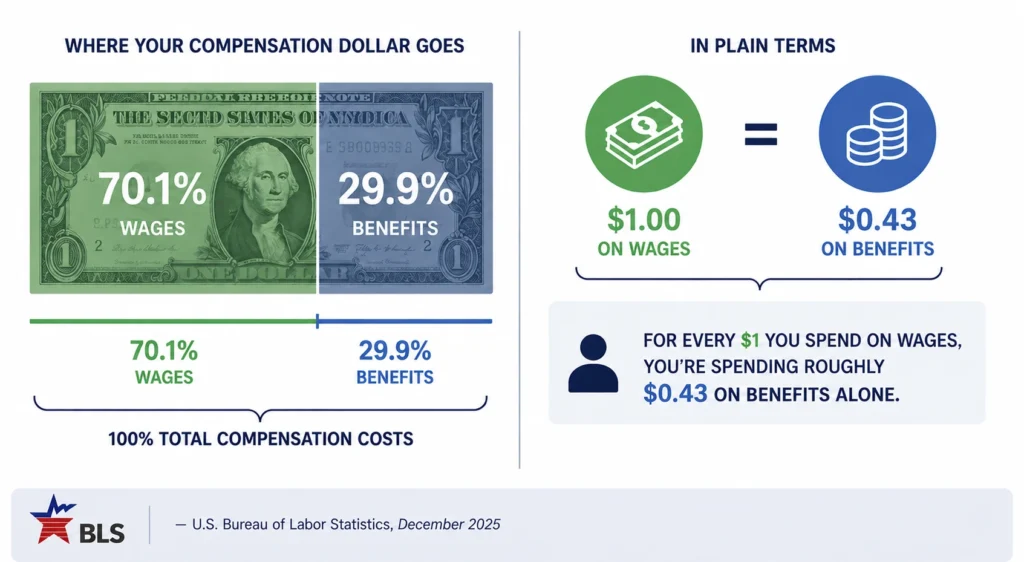
According to the U.S. Bureau of Labor Statistics’ Employer Costs for Employee Compensation report (December 2025), benefits account for 29.9% of total compensation costs for private industry workers. In plain terms, that means for every dollar you spend on wages, you’re spending roughly an additional 43 cents on benefits alone.
Benefits typically add 30–40% on top of base salary for full-time private sector employees. A $60,000 salary becomes $78,000–$84,000 in total annual compensation cost once you factor in health insurance, retirement contributions, paid leave, and legally required taxes.
— U.S. Bureau of Labor Statistics, December 2025
And that’s before you account for:
- Recruiting costs — job postings, screening time, interviews
- Onboarding — new employees take 3–6 months to reach full productivity, compared to 2–4 weeks for a virtual assistant (Wishup, 2026)
- Equipment — computer, software licenses, desk, or office space if applicable
- Payroll taxes — the employer’s share of FICA alone adds 7.65% to every dollar of wages
- Turnover risk — the cost of replacing an employee is typically 50–200% of their annual salary
So that $55,000 hire? By the time you’ve added benefits, payroll taxes, recruiting costs, and equipment, you’re likely looking at $72,000–$90,000 or more in real annual cost. For a small business or nonprofit watching every dollar, that’s a significant commitment — one that comes with fixed overhead regardless of your revenue fluctuations.
What a Virtual Assistant Actually Costs
A U.S.-based virtual assistant typically charges on an hourly or retainer basis. Rates vary by experience and specialization — a general admin VA might charge $25–$40 per hour, while a credentialed specialist (like a PMP-certified VA or QuickBooks ProAdvisor) commands higher rates that reflect deeper expertise.
Here’s what you don’t pay for with a VA:
- No employer payroll taxes
- No health insurance or retirement contributions
- No paid time off you’re responsible for covering
- No equipment or office space
- No recruiting fees or onboarding overhead
- No termination risk or unemployment claims
You pay for the hours or the scope of work — and nothing else. During slower seasons, you scale down. During busy periods, you scale up. That flexibility simply doesn’t exist with a full-time hire.
Hiring full-time virtual assistants could save a U.S. employer more than $11,000 per year compared to an equivalent in-house hire.
— DDIY.co’s 2026 virtual assistant statistics
For U.S.-based VAs specifically, savings typically run 15–25% lower than a comparable full-time employee — while offshore VAs can deliver cost reductions of 60–80%. (Wishup, 2026)
The Side-by-Side Comparison
Here’s how the two models stack up across the factors that matter most for a small business:
| Full-Time Employee | U.S.-Based Virtual Assistant | |
| Base cost | $45,000–$65,000/yr salary | Pay only for hours worked |
| Benefits overhead | +30–40% on top of salary (BLS, 2025) | None — no benefits required |
| Payroll taxes (FICA) | 7.65% employer share | None |
| Equipment & workspace | Computer, desk, office space | None — VA provides their own |
| Onboarding time | 3–6 months to full productivity | 2–4 weeks to full productivity |
| Flexibility | Fixed hours, fixed cost | Scale up or down as needed |
| Termination risk | Severance, unemployment claims | No-contract arrangements available |
| Total annual cost (example) | $60,000 salary = $78,000–$84,000 total | Pay for what you actually need |
When a Full-Time Employee Makes More Sense
To be fair — and I believe in being direct with people — there are situations where a full-time employee is genuinely the right choice. Here are a few:
- You need someone on-site, full-time, managing physical operations that can’t be handled remotely
- You’re at a stage where you need a dedicated culture-builder or leadership presence that requires full organizational immersion
- The role requires deep institutional knowledge that only comes from being embedded in the day-to-day over years
- You’re ready for the full employment commitment and the overhead is justifiable given your revenue and trajectory
None of these situations describe most small business owners who are considering their first hire. In most cases, the capacity gap they’re trying to fill is exactly what a skilled VA is built to address.
What Type of Work Is Best Suited to a VA?
Virtual assistant support works best for work that is: recurring and predictable, process-driven, skills-based rather than relationship-dependent, and manageable remotely with good communication systems.
For a small business or nonprofit, that typically covers a significant portion of the administrative and operational workload. Some of the most common areas I support clients with include:
- Project management — coordinating timelines, tasks, and team accountability
- Bookkeeping — monthly reconciliation, reporting, and QuickBooks management
- Process improvement — documenting SOPs and building repeatable systems
- Digital marketing — social media, email campaigns, and content scheduling
- Administrative support — inbox management, calendar coordination, research
- Automation — Zapier and Make.com workflows to reduce manual work
For each of these functions, hiring a full-time employee would mean paying a full-time salary for work that may only require 10–20 hours per week. A VA lets you access exactly the support you need without the overhead of a position that’s larger than the work requires.
The Question Nobody Asks — But Should
Here’s the question I’d encourage every small business owner to sit with before making a staffing decision: not ‘can I afford to hire someone?’ but ‘what is it costing me not to get help?’
Time is the resource most small business owners are shortest on. Every hour you spend on bookkeeping, admin, project coordination, or social media is an hour you’re not spending on business development, client relationships, or the work that actually grows your revenue. That opportunity cost is real — it’s just harder to put a dollar figure on than a salary.
A skilled virtual assistant pays for itself when it frees you to do the work that matters most. For many small businesses and nonprofits, that’s the more important calculation.
Ready to Explore What VA Support Could Look Like for You?
If you’re weighing your options and want an honest conversation about whether a virtual assistant is the right fit for your business — I’m happy to have it. Let’s chat!